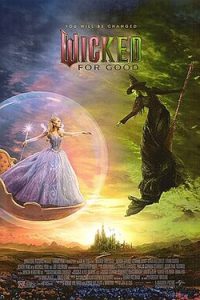
Wicked: For Good continues the story of the magical land of Oz, in which Glinda and Elphaba face turmoil in their rapidly approaching destinies, as they try to find their place in the world, while changing it for the better. Elphaba continues to fight for the animals, while Glinda’s internal conflict leads her to question her beliefs and therefore her entire world. A continuation of the story of Wicked, and based on a broadway musical, movie, and two books, Wicked: For Good was not easy to create. Despite this, it is successful in illustrating the complex themes of friendship, truth, and what it really means to be good.
The movie further develops the world of Oz, with elaborate sets, from the Emerald City palace to Glinda’s room to Elphaba’s tree in the woods, many of which were practical—not created using CGI. This allows the audience to be transported into Oz, as though they are experiencing the vivid land themselves. The magical atmosphere of this movie can be accredited to the deliberate, artful cinematography. This movie is different from its predecessor in that the colors of the setting and even Elphaba’s makeup are darker, in order to show the shift to more serious themes, plot, and emotional development, which contrasts the more frivolous, bright coloring of Wicked. Color contrast is used to show the conflict between Elphaba and Glinda through their representative colors, green and pink. One standout example of cinematography is during “The Girl in the Bubble,” in which mirrors are used to illustrate the emotional journey Glinda experiences as she grapples with others’ perception of her and her perception of herself. Many frames from the newer movie parallel that of the first movie, in order to create a subconscious sense of story arc and character growth.
Elphaba and Glinda become increasingly complex characters in Wicked: For Good whose motives, choices, and beliefs are nuanced. Glinda, portrayed by Ariana Grande, realizes that her idea of happiness is superficial. Her bubble symbolizes perfection—a shiny, spherical shape—and the expectation of Oz that she be an inspiring public figure. When her bubble pops, her facade of flawless popularity dissolves as she chooses to be truly good, even at the expense of her image. Grande’s talent as an actress and vocalist shine through in “Thank Goodness/I Couldn’t Be Happier” and “The Girl in the Bubble,” which show Glinda’s shift from a more lighthearted and whimsical character to a saddened, conflicted one. Elphaba’s character growth is brought to life by Cynthia Erivo. Elphaba has become hardened by her experiences and driven to maturity, rather than her naive hopefulness in the first movie. Erivo’s vocal talent is evident especially in “No Good Deed,” which illustrates Elphaba’s character arc. Both these actresses beautifully and thoughtfully portray the duality and development of their complex characters.
Wicked: For Good’s storyline is enhanced by the iconic songs which bring emotional depth to the movie. One standout song to me is “No Good Deed” because of the raw emotion conveyed through Cynthia Erivo’s vocal talent. This song is accompanied by a breathtaking scene that highlights the desperation and hardened resolve Elphaba faces. Stephen Schwartz, the composer of the Wicked Broadway musical, wrote two new songs for this movie—“No Place Like Home” and “The Girl in the Bubble.” These songs add new interest and depth to the classic story. My personal favorite song from this movie is “For Good,” because of its emotional significance and the poignant ending it brings to the story.
Despite this movie being absolutely magical, I do have a few criticisms of it.The second part of the movie (and Broadway musical) has too many reprises of songs and the music is not as atmospheric as the first movie. The new song, “No Place Like Home,” in which Elphaba attempts to inspire the animals to fight their oppression, added very little to the plot and felt unnecessary. I appreciate the character development of Boq, Fiyero, and Nessarose, which I think was lacking in the first movie. Although I love this continuation of the Wicked story, I enjoyed the first movie more because of its songs, mood, and overall sense of cohesiveness.
This movie’s meaning goes far beyond the story of two friends in a magical land. It explores the idea that “the truth is what everyone believes in,” rather than what is right. Throughout the movie, the truth is withheld from Ozians. They are led to believe that the Wizard of Oz is wonderful, at the expense of Elphaba, who is called the Wicked Witch. We also see this theme in Glinda, whose choice to be silent in the face of injustice comes at a cost. She believed she made the right decision when she stayed in the Emerald City and let Elphaba leave to fight for the animals, but she quickly realizes that “getting your dreams is strange, but it seems a little, well, complicated.” Although she is called Glinda the Good, she is simply complicit in the prejudice, stereotyping, and propaganda that are being used to alienate the animals and give power to the Wizard.
Wicked: For Good does an exceptional job at tying together magical cinematography, theatrical talent, and powerful themes to create an entertaining, impactful movie. Director Jon M. Chu, Cynthia Erivo, and Ariana Grande come together to create a beautiful piece of art: this amazifying movie which changes its audience for good.