







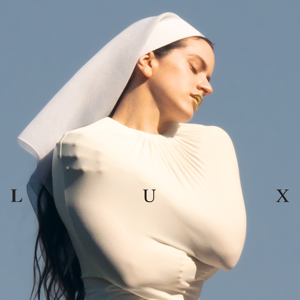
Rosalía’s ambitious and transcendental album Lux reimagines what the future of music–and storytelling through sound–can be. Sung in thirteen languages and arranged into four movements, the Spanish artist blends orchestral composition, pop experimentation, and flamenco tradition into sweeping songs on spirituality, romance, femininity, and transformation.
Released on November 7th, 2025, the album garnered widespread critical acclaim. Metacritic, a review aggregation website that uses a weighted average system to provide a single, summary critic score for music albums, rated Lux a 95/100–labled with “universal acclaim.” PItchfork praised the album as, “an operatic lament for a new generation, an exquisite oratorio for the messy heart.” The publication emphasized that if you come expecting superficial pop songs, you’re likely going to be lost at first; but stay, let the pieces unfurl, and enjoy what’s been revealed.
While passively listening Lux still offers a spine-tingling, sonically and emotionally charged experience, the heart of the album demands attentive dissection by listeners–with layers of meaning, emotion, and history needing unraveling. Rosalía took inspiration for nearly every song from the historical accounts of female religious figures from throughout history, religions, and across continents.
Rosalía opens the album the ascending spanish track “Sexo, Violencia, y Llantas,” introducing the central tension with the (translated) lines: “How nice it’d be | to live between them both | First I’ll love the world | then I’ll love God.” Rosalía positions herself between heaven and earth from the onset, a duality that guides the rest of the album.
In “Porcelana,” Rosalía references the story of Ryōnen Gensō, a Japanese Zen Buddhist monk and poet who disfigured her own face with a hot iron after being blocked by a Buddhist master from monastic life. He claimed she would be a distraction to male students–hollowly reducing her to her beauty. Through dramatic strings and after rap lyrics, the (translated from Japanese) lyrics read: “I’ll tear off my beauty | before you do it for me | if you think I’m crazy | that’s the gift I was born with.” Rosalía interprets Gensō’s sacrifice as one of female liberation and devoation–a tale a woman choosing her own path over the one assigned by men.
The orchestral crescendo of “Berghain” stands as one of Lux’s most sonically overwhelming moments. Featuring Bjork and Yves Tumor, the track compacted desire, despair, and transcendence into impactful German, Spanish, and English lyrics. The collaboration serves as a testament to Rosalía’s ability to command complexity without hampering emotional impact.
“Berghain” is followed by the catchy waltz “La Perla” riddled with creative insults and snarky comments aimed at ex-lovers. This tune carries into the flamenco-pop song “De Madrugá,” where Rosalía asserts she has, “every right | to get even,” then in Ukrainian stating, “I don’t want revenge | revenge wants me.”
On “Novia Robot” corrupted strings and a dystopian monologue blurs the boundaries of pop, critiquing the objectification of women in a mechanized world. Rosalía laments with the (translated from Hebrew) lyrics, “I was born to rebel | and I rebel to be born again | if pressure makes diamonds | why then aren’t we all shining?”–ending the song with a haunting question on suffering, resilience, and value.
The album closes with the beautiful song “Magnolias” as she imagines her funeral through an ascending chorus–begging people to throw flowers over her casket. Returning to the idea of living in between God and the world with the (translated from Spanish) lyrics, “when God descends I ascend | we’ll meet halfway…I come from the stars | and today I turn to dust | to go back to them.”
Physical editions of the album include eighteen tracks, some of which–such as “Focu ‘Ranni,” “Novia Robot,” and “Jeanne”—are absent from the online streaming platforms. Later this year she begins the “Lux Tour” with destinations across three continents starting in Lyon, France, and ending in San Juan, Puerto Rico.
Rosalía’s Lux is an album that resists superficial listeners, rewarding those who allow themselves to sit with its questions, feel its sonic composition, and understand its lyrics. It ascends to the heavens and then returns to the tires of our world–a reminder that transformation often happens in the space between devotion and desire.